
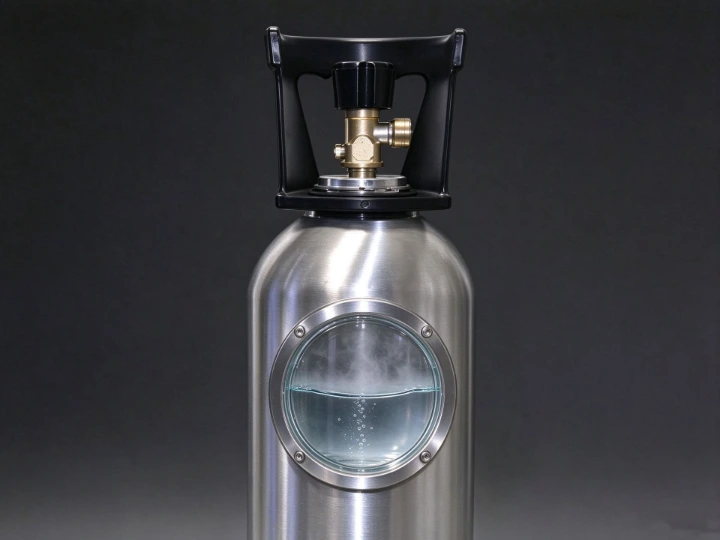
The carbon dioxide in the pressure tank "automatically vaporizes" when it exceeds 31.1 °C because the carbon dioxide has reached itsCritical Point。
In physics, the critical temperature of carbon dioxide is 31.1 °C, and the critical pressure is 7.38 MPa (about 72.8 atmospheres). After exceeding this temperature, the physical state of carbon dioxide undergoes a fundamental change:
Whether it can successfully revert to liquid depends onthe sealing condition inside the tankandthe matching relationship of the cooling range:
Seal not broken (can automatically recover):
Supercritical state cooling (cooling after heating above 31.1 °C): When the temperature drops back from above 30 °C to below 31.1 °C (and the pressure inside the tank remains above 5.18 atm / 0.52 MPa), the carbon dioxide will cross the critical point, the phase interface will reappear, and it will automatically reconstruct into alower liquid layer and upper gas layer gas-liquid coexistence state.
Ordinary vaporization cooling (vaporization caused by pressure reduction/venting): If it is through cooling or re-pressurization (maintaining high pressure), the gas will also re-condense back into liquid.
Seal already broken (cannot recover to the original amount):
If the temperature is too high, causing the pressure inside the tank to surge and triggering the explosion-proof valve (rupture disc), a large amount of carbon dioxide has already been released to the outside, so the total mass inside the tank decreases. Even if it is subsequently cooled,only a very small amount of liquid can be recovered, or it will completely become low-pressure gas。